The stablecoin revolution has officially arrived in travel commerce. Visa announced in late April that it is expanding its global stablecoin settlement pilot to include five additional blockchains, bringing the total to nine networks. The company revealed that its annualized stablecoin settlement run rate has reached $7 billion, up 50% in a single quarter.
For travel merchants, this is not a distant possibility. It is a present-day shift with immediate implications for how airlines, hotels, and online travel agencies process international transactions.
What the Expansion Means for Travel Commerce
Visa’s pilot now supports settlements on Arc, Base, Canton, Polygon, and Tempo, alongside existing networks. The company is not just experimenting with digital assets. It is building infrastructure for mainstream adoption across global payment corridors.
For travel businesses, this translates to faster cross-border settlement, lower transaction costs, and a new pathway for serving underbanked travelers in high-growth markets. Airlines and hotels operating internationally have long wrestled with currency conversion delays, correspondent banking fees, and settlement windows that can stretch several days. Stablecoin rails offer a direct alternative.
Stablecoins Bring Predictability to Travel Payments
The appeal for travel operators goes beyond speed. Stablecoins like USDT and USDC are pegged to the US dollar, which means merchants can accept digital assets without exposure to crypto price volatility. This is a critical consideration for an industry where margins are thin and currency fluctuations can erase profit on a single booking.
Paul van Alfel, a travel payments expert at The Paypers, noted in a January analysis that major buzzwords in travel fintech for 2026 center on agentic commerce for consumer bookings, with hotel payments leading adoption, and stablecoins gaining ground in B2B transactions. The conditions for that B2B shift are now visibly taking shape.
Travel payment platforms are taking notice. Karta.io, for example, enables travelers to fund an account with USDT or USDC and pay anywhere Visa is accepted, including hotel bookings and airline tickets. Bitpace, another crypto payment processor, supports more than 70 leading cryptocurrencies and offers real-time dashboards for transaction reconciliation, allowing finance teams to manage digital asset revenue with the same clarity they expect from traditional card processing.
Who This Benefits Most
Emerging market travelers stand to gain the most from this shift. Customers in regions where credit card penetration is low but smartphone adoption is high can now participate in the global travel economy using digital wallets and stablecoin rails. For travel merchants targeting growth in Southeast Asia, the Middle East, and Latin America, accepting stablecoins opens new customer segments that were previously difficult to serve.
Corporate travel managers are also watching closely. Multi-leg business trips involving multiple currencies have historically created complex reconciliation challenges. Stablecoin settlements that clear in seconds rather than days could simplify corporate travel accounting significantly.
Operational Considerations for Travel Operators
Integrating stablecoin acceptance does require operational changes. Merchants need compliant crypto payment infrastructure, staff familiarity with digital asset bookkeeping, and a strategy for converting stablecoin receipts into operational capital. Several payment processors now offer instant conversion to fiat currency, which reduces exposure but does not eliminate the need for internal accounting adjustments.
Regulatory clarity varies by jurisdiction, and travel businesses operating across multiple markets will need to monitor evolving frameworks for digital asset payments. However, the direction of travel is clear. With Visa committing $7 billion in annualized stablecoin settlements and expanding its blockchain network, stablecoin rails are becoming a legitimate part of the travel payments stack.
The travel merchants who begin building that infrastructure now will be positioned to compete more effectively as digital asset adoption accelerates through the rest of 2026 and beyond.
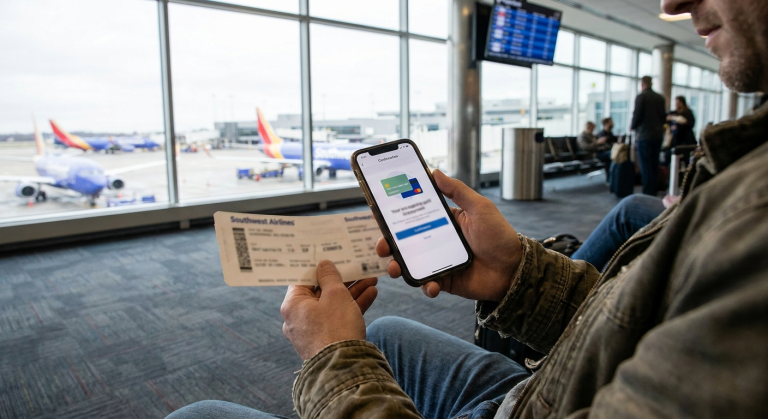
Featured image: Professional stock photography. Documentary style. Natural lighting. Airport terminal with digital payment screen and traveler using mobile device. Shallow depth of field. Canon EOS R5 quality.