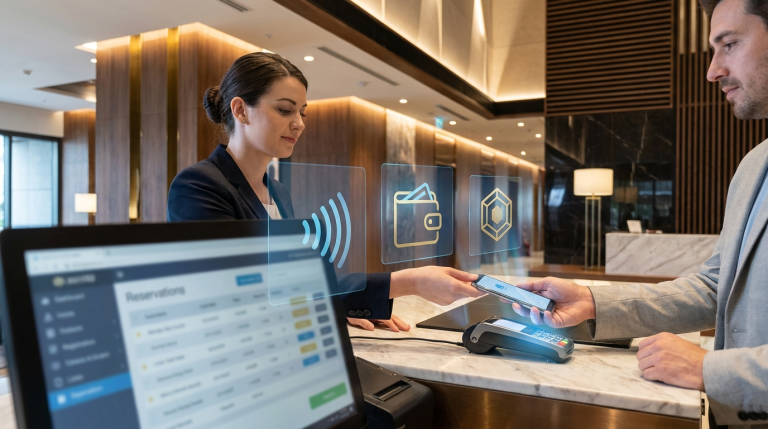

How Hotels Are Turning Payment Infrastructure Into a Competitive Weapon
The hotel industry is waking up to a reality that fintech has known for years: payments are not just a cost center. They are a strategic lever for revenue optimization, guest satisfaction, and operational efficiency. At ITB Berlin 2025, the message from hotel chains, technology providers, and payment processors was clear. The properties that treat payments as a core capability will outmaneuver those still viewing it as a back-office afterthought.
The Shift in Mindset
Edgar, Dunn & Company presented a whitepaper at ITB Berlin titled “Five Best Practices to Unlock the Hidden Potential of Payments for Hotel Chains.” Their research validates what industry conversations confirmed. C-level executives at major hotel chains now view payment strategy as directly tied to revenue optimization and guest experience. This is a sharp departure from the traditional approach where payments were treated as a service and cost burden.
The pain points driving this shift are persistent and costly:
- Decentralized payment systems from diverse ownership structures
- High acceptance costs from continued card payment dominance
- Property-centric currency handling that creates friction for international guests
- Fraud, chargebacks, and reconciliation headaches that drain resources
Hotels are increasingly moving toward Payment as a Service (PaaS) models. These API-first solutions let hotel technology companies embed payment capabilities directly into their platforms. The result is a seamless, secure, multichannel payment experience without the legacy infrastructure headaches.
The Chargeback Crisis
Chargebacks represent one of the most immediate threats to hotel profitability. According to research cited by Elavon, the travel and hospitality industry sees average chargeback ratios between 0.89% and 2.0%. Each case costs hotels $25 to $30 in direct fees alone. That does not account for the operational drag of dispute management, staff time diverted from guest service, or the reputational damage with card networks and franchisors.
Perhaps more alarming is the source of these disputes. Mastercard research indicates that 50% of chargebacks are now initiated instead of refund requests. Guests are increasingly bypassing hotel customer service and going straight to their banks. This trend, known as first-party fraud or friendly fraud, has surpassed account takeover as the largest fraud threat to merchants globally.
The consequences extend beyond individual transactions. High dispute ratios can trigger increased scrutiny from payment processors, higher processing fees, and strained relationships with franchisors. For franchise owners, this creates a compliance risk that can affect their entire operation.
Prevention Over Reaction
The most effective chargeback strategy is prevention. Hotels that wait until disputes arrive are already losing. Industry best practices now center on proactive documentation and clear guest communication.
Key prevention tactics include:
- Requiring click-to-accept terms and conditions during online booking
- Verifying online bookings with ID and payment card at check-in
- Accepting in-person payments only with the physical card present using EMV-enabled terminals
- Maintaining detailed transaction records including receipts, check-in confirmations, and guest signatures
Technology is playing an expanding role. Automated alerts notify management immediately when disputes arise. Machine learning and fraud scoring analyze bookings for suspicious patterns, allowing hotels to review risky transactions while letting legitimate ones proceed. Integration with payment service providers simplifies evidence submission, reducing manual work and speeding resolution.
The Revenue Impact of Payment Friction
According to the Payrails Hospitality Industry Trends 2025 report, the numbers paint a stark picture of what payment inefficiency costs the industry:
- $21 billion spent annually on payment processing
- 5-6% of hospitality revenue lost to fraud
- 30% year-over-year increase in chargebacks
- 31% of hotels report that manual reconciliation delays growth
On the guest side, the data is equally compelling. 74% of travelers abandon bookings if their preferred payment method is not available. 91% want to pay in their home currency. For European travelers specifically, 38% say they are more likely to book directly when digital wallets are available.
The buy now, pay later (BNPL) trend has cemented its place in travel. One in five U.S. Travelers now uses BNPL to book trips, with usage up 50% year-over-year across major travel sites. Hotels that fail to offer these options are effectively turning away bookings before they happen.
Tokenization and Authorization Optimization
Network tokenization is emerging as a critical tool for improving payment performance. Visa and Mastercard both report 2-4% lifts in authorization rates when tokenization is deployed. This matters enormously in hospitality where bookings are often high-value and cross-border. A failed authorization does not just mean a lost sale. It means a frustrated guest and potential churn to competitors.
Tokenization also reduces fraud exposure by replacing sensitive card data with secure tokens. With over 4 million travel-related credentials compromised since 2021, the risk of card-not-present fraud (which accounts for 65% of fraud losses) is a constant threat. Tokenization addresses this without adding friction to the guest experience.
Embedded Payments and the Invisible Checkout
The future of hotel payments is invisible. Guests increasingly expect frictionless, mobile-first experiences where payment happens seamlessly within the booking flow. Embedded payments make this possible by integrating checkout directly into hotel apps and websites, removing the redirects and handoffs that cause abandonment.
For hotel chains, this creates an opportunity to recapture direct bookings from online travel agencies. When the payment experience is smooth, localized, and offers preferred payment methods, guests have less incentive to book through third parties. Given that hotels lose 0.8-2% of room revenue to OTA and payment friction, the financial case for investment is clear.
Key Takeaways
- Payments are strategic. Leading hotel chains now treat payment infrastructure as a revenue driver, not a cost center. C-level executives are actively involved in payment strategy decisions.
- Chargebacks are a systemic threat. With costs of $25-30 per case and 50% of disputes initiated instead of refunds, prevention through clear communication and documentation is essential.
- Guest expectations have shifted. 74% abandon bookings without preferred payment methods. BNPL, digital wallets, and local currency support are now baseline expectations.
- Tokenization delivers measurable results. 2-4% authorization rate improvements translate directly to recovered revenue, especially in high-value cross-border bookings.
- Embedded payments reduce OTA dependence. Seamless checkout experiences drive direct bookings and reduce the 0.8-2% revenue loss to friction and third-party commissions.
The hotel industry stands at an inflection point. The properties that modernize their payment infrastructure will capture market share from those stuck with legacy systems. In a sector where margins are tight and guest loyalty is fragile, payments may be the most underrated competitive advantage.