
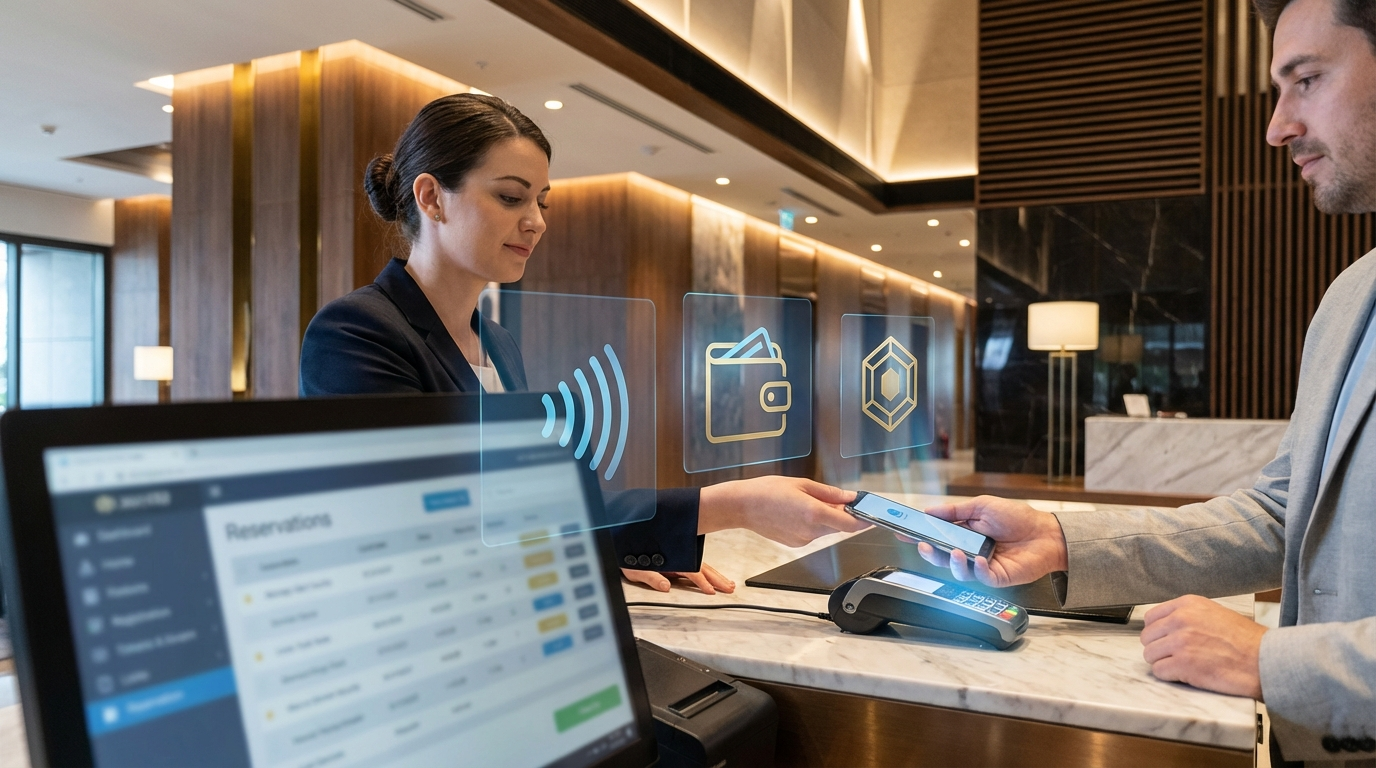
Hotels are sitting on a payment problem: “card-on-file” complexity
Hotels love the convenience of storing a guest’s card for deposits, preauthorizations, incidentals, no-show fees, and post-stay charges. But card-on-file workflows are exactly where friction, declines, and fraud tend to show up: the reservation is made days (or weeks) before the final capture, amounts change at checkout, and the guest may not be present when a follow-on charge is attempted.
That’s why the card networks’ push toward tokenized digital credentials matters for hospitality. In 2025, Visa executive Jack Forestell said tokenized transactions deliver about a five percentage point increase in the likelihood a payment is completed and about a 40% lower fraud rate compared to non-tokenized transactions. (Source: Payments Dive)
For hotels, those are not abstract benefits—they map directly to fewer failed deposits, fewer “couldn’t collect” cancellation fees, and less back-office time resolving payment issues.
What “tokenization” means in practice (and why hotels should care)
Tokenization replaces raw card data (the PAN) with a token that can be safely stored and used for future transactions. In hospitality, tokenization typically shows up in two forms:
– Device / wallet tokenization (e.g., Apple Pay / Google Pay): Great for in-person check-in and contactless payments.
– Network tokenization (often discussed as “network tokens” for card-on-file): Designed for ecommerce and stored credentials where the guest isn’t present.
The second one is the big opportunity for hotels because it targets the highest-friction moments: booking engines, OTA-style card-not-present flows, and post-booking charges.
Stripe summarizes the operational goal clearly: use tokenization to store a secure version of the card so it can be reused without re-entering details or exposing raw card data. (Source: Stripe)
Where hotels get hit today: 5 common “card-on-file” failure points
Tokenization isn’t magic, but it’s particularly well-suited to reducing pain in a few repeatable places:
1) Deposit collection at booking
– Failure mode: soft declines, issuer friction, extra authentication, or a blocked transaction.
– Why tokenization helps: issuers can recognize tokenized credentials as more trustworthy, reducing “false declines” in many cases.
2) Preauthorization at check-in
– Failure mode: mismatched amounts, repeated authorizations, and guest confusion about holds.
– Practical note: tokenization doesn’t replace good guest communication—clear descriptors and transparent policies still matter.
3) Incremental authorizations during the stay
– Failure mode: multiple adjustments and reauth attempts trigger issuer suspicion.
– Opportunity: cleaner stored-credential handling reduces the odds that issuers treat a later charge as “out of pattern.”
4) No-show and late cancellation fees
– Failure mode: you attempt to charge after the scheduled arrival time and get a decline (or a dispute later).
– Opportunity: stronger stored credential + better data handling reduces both declines and “I didn’t authorize this” disputes.
5) Post-stay charges (damage, minibar, missing items)
– Failure mode: guest is gone; the card is expired/updated; follow-on charge fails.
– Why tokenization helps: tokenized credentials are designed to keep stored payment details usable even as underlying account details change.
How tokenization intersects with hotel systems (PMS, booking engines, and processors)
The easiest way to think about tokenization in hotels is: it’s not a “payments team” project; it’s a systems integration project.
A modern hotel stack might include:
– Booking engine (direct)
– Channel manager / OTAs
– Property management system (PMS)
– Payment gateway/processor
– Fraud tooling and chargeback handling
– Accounting and reconciliation
Stripe notes that hotel payment systems need to tie every transaction back to a reservation and stay in sync with the PMS and accounting tools—or you end up with manual work and record gaps. (Source: Stripe)
What to ask vendors (the practical checklist)
When a vendor says “we support tokenization,” the operational questions that matter are:
– Whose token is it? Gateway token, vault token, or network token?
– Portability: if you change processors, can you keep the stored credentials?
– Stored credential indicators: do they correctly flag “card on file,” recurring-like follow-ons, and incremental auths?
– Multi-channel consistency: can you reconcile the same guest across direct + OTA bookings without fragmenting tokens?
– Fallback behavior: what happens if a token cannot be provisioned—do you drop to PAN storage (bad) or a vaulted gateway token (better)?
Security isn’t the only reason networks are pushing tokenization
The public narrative around tokenization has long been “security.” That’s true, but the networks are also explicit that tokenization is about higher completion rates and lower fraud in digital transactions.
Payments Dive, citing Visa and Mastercard executives at an investor conference, describes tokenization as a way to both increase the share of completed digital transactions and reduce fraud—while also reducing declined payments for consumers. (Source: Payments Dive)
For hotels, that’s important because payment friction doesn’t just hurt collections; it can hurt conversion. A failed booking charge can mean a lost reservation. A messy check-in authorization can create a front-desk experience that feels broken.
Implementation approach: what a realistic rollout looks like
Hotels don’t need a “big bang” conversion. A pragmatic rollout often looks like:
1) Start with direct web bookings
– Highest control, easiest to instrument and measure.
2) Tighten stored-credential hygiene
– Make sure your processor is passing the right indicators for card-on-file and follow-on transactions.
3) Add wallet-first options for mobile
– Wallet payments reduce key-entry errors and add biometric confirmation in many cases.
4) Measure the right KPIs
– Booking conversion rate
– Auth rate (initial + incremental + post-stay)
– Fraud/chargebacks on card-not-present flows
– “Uncollectible” fees (no-show/cancellation)
5) Expand to multi-property and channel manager flows
– This is where the system design matters most.
Key takeaways
– Tokenization is moving from “nice security feature” to a core lever for approval rates and fraud reduction in digital payments.
– Hotels are disproportionately exposed because hospitality relies on card-on-file and follow-on charges across long booking-to-stay windows.
– Don’t accept vague “we support tokenization” claims—push vendors on token type, portability, and PMS/booking-engine integration.
– Roll out in phases and measure auth rates across the full guest lifecycle: booking → check-in → stay → checkout → post-stay.
—
Sources
– Payments Dive — “Visa, Mastercard push more tokenization” (Sep 10, 2025): https://www.paymentsdive.com/news/visa-mastercard-push-more-tokenization/759762/
– Stripe — “Hotel payment processing explained” (accessed Feb 8, 2026): https://stripe.com/resources/more/hotel-payment-processing