
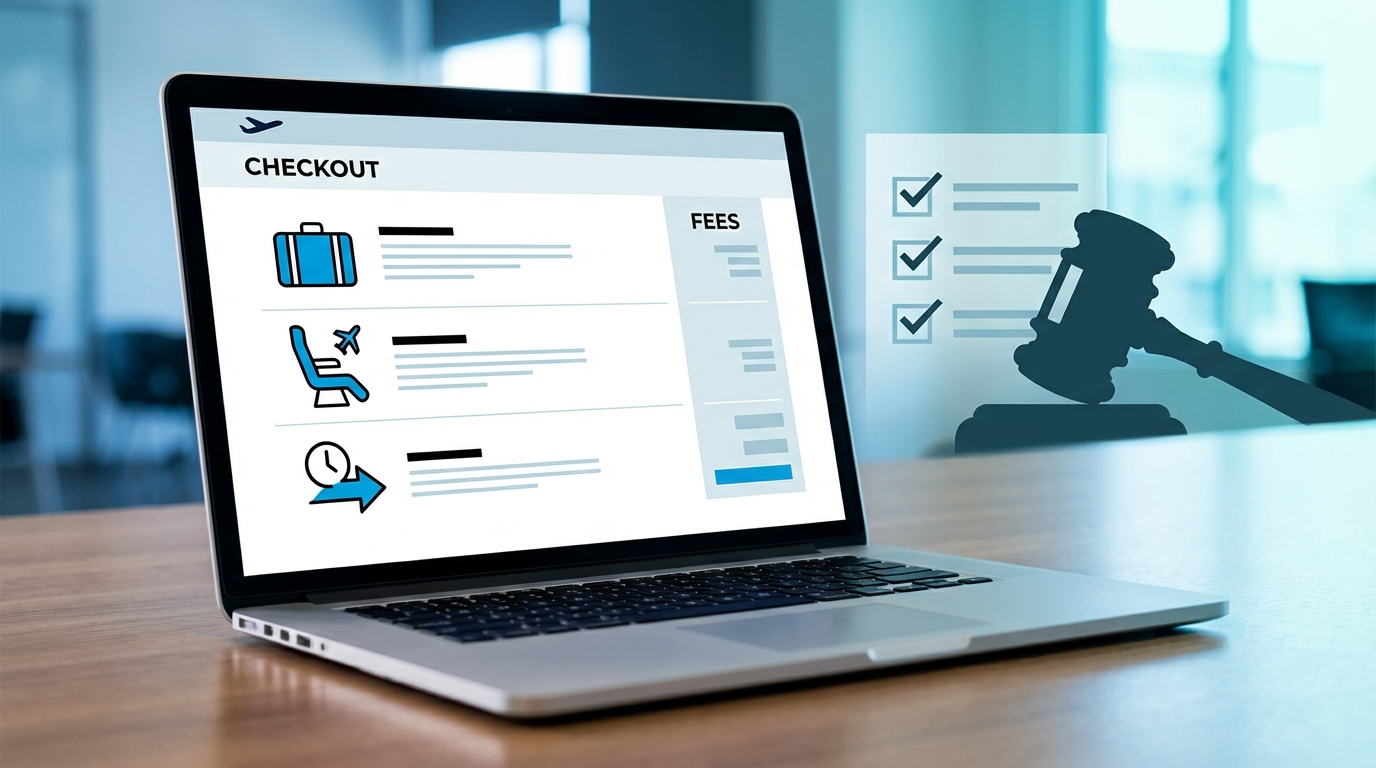
Airline ancillary fees just became less standardized at the exact moment most travel sellers are trying to make checkout more predictable.
On Feb. 3, the 5th U.S. Circuit Court of Appeals (en banc) vacated the U.S. Department of Transportation’s “ancillary fee” disclosure rule on procedural grounds, rolling back a Biden-era attempt to force airlines and ticket agents to show certain baggage/change/cancel fees earlier in the booking flow. The decision doesn’t erase consumer demand for transparency—but it does change the compliance map for airlines, OTAs, TMCs, metasearch, and anyone else assembling airfare + add-ons into a single cart.
For travel merchants, the operational question is simple: do you build for the lowest common denominator (inconsistent fee data) or the customer expectation (itemized, upfront, comparable totals)—and how do you protect margins and chargeback exposure when totals change late in the funnel?
What happened (and why it matters)
The DOT’s final rule (“Enhancing Transparency of Airline Ancillary Service Fees”) was designed to require clearer, passenger- and itinerary-specific disclosures for “critical” ancillary fees—think checked baggage, carry-on baggage, and change/cancellation fees—whenever fare and schedule information is presented. In practice, it was pushing the ecosystem toward a more “all-in” shopping display where consumers could compare true trip cost earlier.
This week’s ruling vacated that framework. Reuters reports the court set aside its prior view that DOT had authority to require upfront fee disclosure and notes the airline industry argued the regulation would “upend the way airlines interact with their customers, at great cost, and with no demonstrated benefit.” DOT previously estimated consumers overpaid hundreds of millions annually due to surprise fee differentials (e.g., paying more at the airport vs. paying in advance).
For sellers, the headline isn’t just “a consumer rule got tossed.” The bigger impact is that the industry loses a clear forcing function for standardization—and standardization is what makes downstream operations (pricing integrity, customer service scripts, refunds, disputes) cheaper.
The merchant/operator angle: where the pain shows up
1) Late-funnel price changes increase disputes
Ancillary fees are one of the most common triggers for “I didn’t agree to that” customer complaints. When fees appear late—or vary by channel—merchants see:
– Higher contact rates (calls/chats) at time of booking
– More voids and failed checkouts
– More chargebacks and retrieval requests on the total transaction amount
Even if the fee is legitimate, a confusing fee story is a chargeback story.
2) Checkout UX becomes a competitive advantage (again)
With less regulatory pressure to harmonize displays, the market reverts to “best operator wins.” The best checkouts will:
– Itemize add-ons clearly
– Capture explicit consent for optional services
– Preserve an auditable record of what was shown
If your channel can’t reliably show the fee picture early, your “advantage” shifts from price to trust. That’s good for brands that invest in UX and customer support—and brutal for thin-margin arbitrage sellers.
3) Data access and timing: the quiet battleground
A rule like DOT’s effectively tells data suppliers (airlines) and intermediaries (GDS, NDC pipes, aggregators) that fee information must be available in a usable way. When that push weakens, fee data can remain:
– Incomplete (not all fees returned)
– Non-comparable (different definitions across carriers)
– Time-shifted (returned only at later steps)
Travel sellers should assume fee data quality will vary by carrier, by channel, and by itinerary.
What to do now: practical moves for travel merchants
1) Treat fee transparency as a revenue-protection project
Don’t frame this as a “compliance” initiative. Frame it as:
– Conversion protection (drop-off reduction)
– Support cost containment
– Dispute prevention
Assign ownership like you would for fraud rates or refund backlog.
2) Make ancillary consent explicit
Where you sell ancillaries (bags, seats, upgrades, insurance), make sure your flow:
– Separates required vs. optional costs
– Uses clear language on when fees apply (per passenger / per segment)
– Confirms selections with a final itemized review
Then store what the customer saw (screenshots/HTML snapshots, line-item objects, timestamps, and carrier rule IDs where available). If you ever have to defend a dispute, evidence beats policy.
3) Engineer for “fee volatility”
In a less standardized world, build your pricing stack with the expectation that the total may change between search → select → payment.
Operationally that means:
– Display “price includes X; additional fees may apply” only when you truly cannot compute the fee (avoid blanket disclaimers)
– Add a “fee refresh” step right before payment authorization
– If totals change, show a delta (“+ $35 checked bag”) and force reconfirmation
This reduces the chance of accidental “surprise” fees and improves post-transaction defensibility.
4) Revisit who is the merchant of record (MoR) for bundles
If you bundle airfare with other services (hotel, car, ancillaries, memberships), clarity around MoR matters.
Ask:
– If an airline fee changes, who eats the difference?
– Who owns refunds, partial refunds, and exchange workflows?
– If a dispute occurs, can you provide documentation that maps to the cardholder’s expectation?
If your MoR model relies on “we’ll reconcile later,” late-fee volatility will eventually become a margin leak.
5) Watch for policy whiplash—and build optionality
Even though this rule was vacated, the broader consumer-protection trend isn’t going away. Different administrations, state attorneys general, and private litigation can reintroduce pressure for disclosure.
Design your stack so you can:
– Turn on deeper disclosures per market
– Support different fee display rules per channel
– Swap fee data sources if one carrier channel degrades
In other words: build the capability as a feature flag, not a hard-coded assumption.
The bottom line
Vacating the DOT ancillary fee disclosure rule doesn’t eliminate the business need for transparency. It simply pushes the cost of clarity back onto operators—airlines, agencies, OTAs, and merchants—who now have to choose between doing the hard work of itemization or paying the tax in churn, support volume, and disputes.
If you’re selling travel in 2026, the winning play is to behave like the rule exists—because your customers already act like it does.
—
Sources
– Reuters (Feb. 3, 2026): Airlines win challenge to appeals court ruling on consumer fee disclosures — https://www.reuters.com/legal/government/airlines-win-challenge-appeals-court-ruling-consumer-fees-2026-02-03/
– Federal Register (Apr. 30, 2024): Enhancing Transparency of Airline Ancillary Service Fees — https://www.federalregister.gov/documents/2024/04/30/2024-08609/enhancing-transparency-of-airline-ancillary-service-fees