
How Payment Technology Is Quietly Powering More Sustainable Tourism
The sustainable tourism conversation usually starts with aircraft, hotels, and destinations. Increasingly, though, the payment layer is where travelers actually make low-carbon choices real. From transit turnstiles to card-linked incentives, the way people pay is becoming a practical lever to cut emissions and steer demand toward greener options.
Why payments matter for sustainable tourism
Travel and tourism’s greenhouse gas emissions remain significant, even as the sector improves its efficiency. Recent analysis from the World Travel & Tourism Council shows that global travel and tourism greenhouse gas emissions in 2024 were 9.3% lower than in 2019, while the sector’s GDP footprint grew by 6%. Emissions intensity has fallen by 15%, helped in part by more efficient operations and a shift toward lower-carbon energy sources.[1]
To keep that curve bending, the industry needs tools that nudge millions of small choices in a lower-carbon direction. That is where payments technology comes in.
Rewarding greener aviation choices
Aviation is one of the most visible pressure points in the sustainability debate. Airlines are experimenting with sustainable aviation fuel, electric aircraft tests, and more efficient fleets, but they also need demand-side tools that influence how people fly.
World Economic Forum research highlights how payment technology can be used to promote more sustainable aviation. Some airlines are already using reward cards to incentivize behaviors such as flying on routes served by newer aircraft, traveling with lighter baggage, or contributing to sustainability partnerships. For example, Etihad Airways’ “Conscious Choices” program allows loyalty members to earn extra rewards when they carry less luggage or donate miles to approved environmental organizations.[2]
Card issuers and co-branded travel partners can build on this approach in several ways:
- Tiered rewards for lower-carbon options. Offer higher earn rates when travelers choose flights with lower estimated emissions, book rail instead of short-haul flights on eligible routes, or select nonstop itineraries when practical.
- Automatic contributions to verified climate projects. Allow travelers to opt into small per-transaction contributions that are pooled into high-quality mitigation or adaptation projects, provided the underlying projects meet credible standards.
- Corporate controls and reporting. For business travel programs, integrate card-level data with emissions dashboards so travel managers can see the impact of routing and carrier choices, and set policies that favor lower-carbon itineraries where possible.
Making low-carbon transport the easy default
On the ground, payments can make public and shared transport feel seamless, which is critical if destinations want to shift demand away from private cars and short-haul flights. Contactless payments on buses, trams, and metro systems reduce friction and can meaningfully improve system efficiency.
In one urban mobility study cited by the World Economic Forum, contactless tap-to-pay reduced bus idling compared with cash payments because passengers boarded more quickly. Less idling means lower local emissions, but the benefits extend further: when transit is faster and more predictable, travelers are more willing to choose it over higher-carbon options.[2]
For tourism boards and city authorities, that suggests a clear set of payment priorities:
- Open-loop acceptance. Enable visitors to use the same contactless cards or mobile wallets they use at home across transit systems, bike-share schemes, and regional rail.
- Integrated caps and passes. Use account-based ticketing so travelers automatically receive the best fare without needing to master local products or machines.
- Real-time incentives. Combine payments data with crowding and emissions models to nudge travelers toward off-peak journeys or lower-carbon modes through instant discounts or loyalty points.
Bringing carbon visibility into everyday spending
Another emerging role for payments in sustainable tourism is education. Card networks and issuers are starting to embed carbon-footprint estimates into banking apps, giving consumers a rough view of the emissions associated with their spending.
Visa’s Ecobenefits service bundle, for example, allows banks and card issuers to offer sustainability features such as displaying estimated carbon impacts alongside card transactions. The solution is underpinned by ecolytiq’s sustainability-as-a-service platform, which analyzes spending data and maps it to emissions estimates.[2]
For travel, that kind of feedback loop could evolve in several useful directions:
- Trip-level insights. Present an end-to-end view of the footprint of a specific trip across flights, hotels, local transport, and activities, tied to the card used for booking.
- Actionable recommendations. Instead of abstract scores, suggest concrete alternatives such as choosing a rail connection for part of an itinerary or booking a hotel with stronger sustainability certifications.
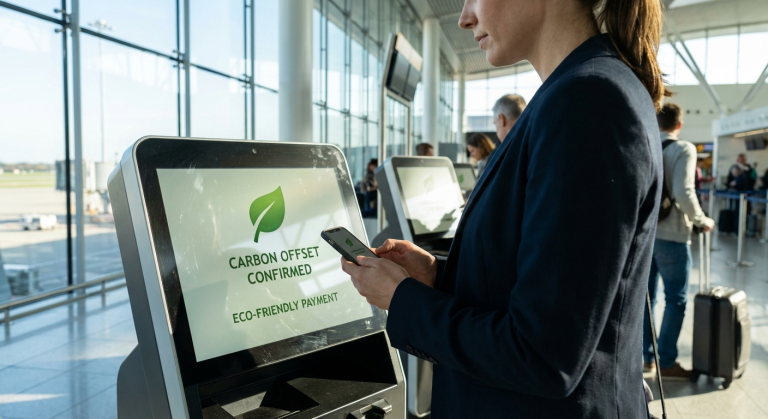
- Transparent offset options. When offsets are offered at checkout, clearly explain the underlying project type, standards, and expected impact so travelers can make informed decisions.
Aligning payment innovation with destination goals
Destinations working on sustainable tourism strategies often focus on infrastructure, regulations, and marketing. Payments rarely top the agenda, but they can quietly reinforce or undermine those efforts. If a city promotes car-free historic districts, for example, but contactless transit and bike-share systems are patchy or confusing for visitors, the payments experience can become a bottleneck.
To avoid that disconnect, tourism boards and payments partners can collaborate on a few practical steps:
- Shared metrics. Include mode share, emissions intensity, and visitor satisfaction with payment experiences in destination dashboards.
- Targeted pilots. Run small-scale experiments that combine transit upgrades with payment incentives in specific corridors or seasons, and measure the impact on traveler behavior.
- Inclusive design. Make sure contactless and digital solutions still work for travelers who rely on cash or have limited access to smartphones and cards, so sustainability gains do not come at the expense of accessibility.
Key takeaways
- Travel and tourism are cutting emissions intensity even as the sector grows, but further progress will depend on influencing everyday traveler choices at scale.[1]
- Payment technology already plays a role in sustainable aviation, from loyalty programs that reward lighter baggage and greener choices to co-branded cards that support environmental projects.[2]
- Contactless and account-based ticketing can make low-carbon transport the default, while emerging card tools give travelers clearer visibility into the carbon impact of their spending.
- Destinations that align payment innovation with their sustainability goals will be better positioned to turn climate ambitions into day-to-day traveler behavior.
Treating payments as part of the sustainable tourism toolkit will not replace aircraft upgrades or new regulations. It can, however, make it easier for travelers to choose the greener option in the moment, which is where many of the next gains in sustainable tourism will need to come from.