
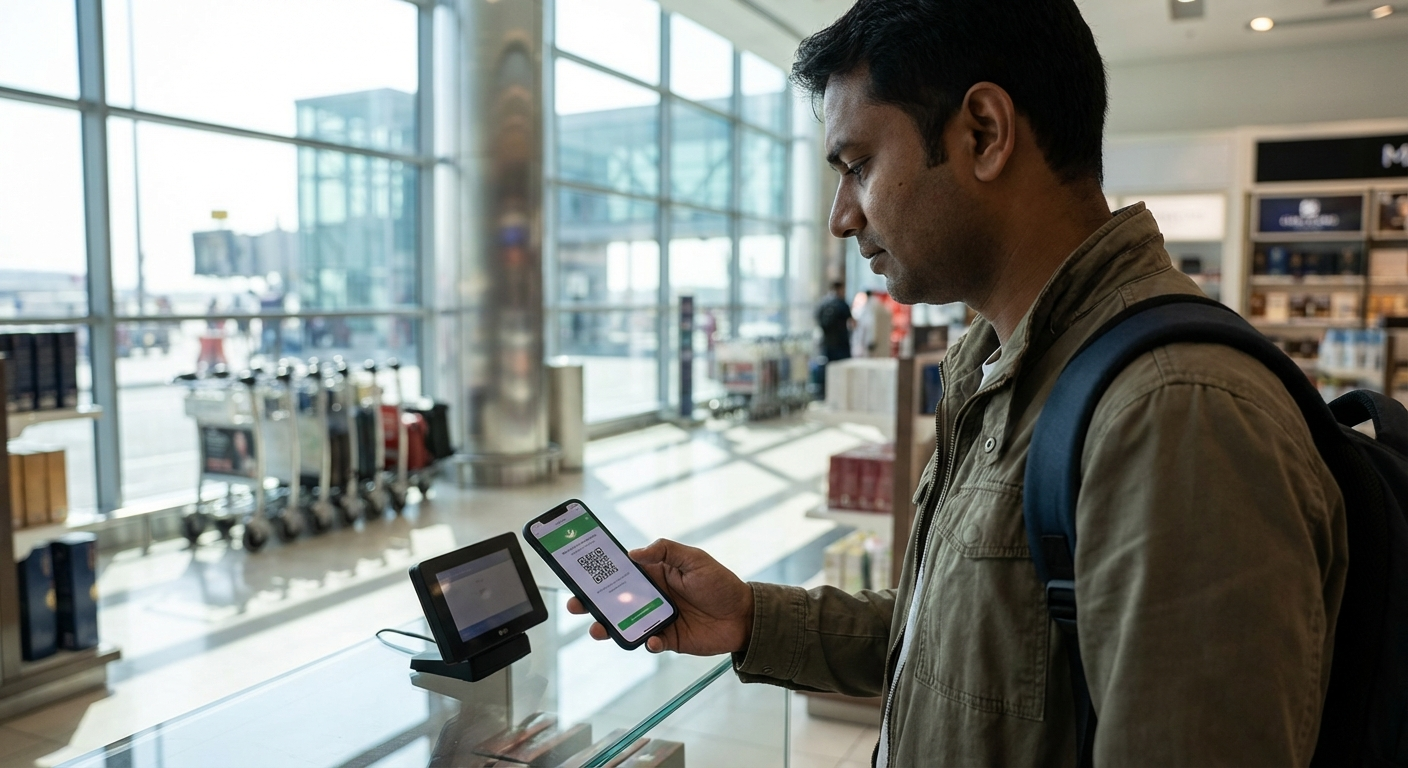
India’s UPI Goes Global: What It Means for Travel Payments
Indian travelers now have a familiar payment option in eight countries. The Unified Payments Interface (UPI), India’s domestic QR-code payment system, has expanded beyond borders. This shift is changing how Indian tourists pay abroad and how merchants in destination markets accept payments.
The Eight Countries Where UPI Now Works
Through partnerships between NPCI International Payments Limited (NIPL) and local banks or payment networks, UPI acceptance is now live in:
- Qatar – The newest addition, launched in partnership with Qatar National Bank (QNB), starting with Qatar Duty Free outlets at airports
- United Arab Emirates – Enabled through Mashreq Bank, covering thousands of merchant outlets in Dubai and Abu Dhabi
- Singapore – Linked to the country’s PayNow system for real-time cross-border transfers
- France – The Eiffel Tower became the first site to accept UPI, with expansion planned
- Bhutan – The first country outside India to adopt UPI
- Nepal – Enabled to deepen cross-border financial connectivity
- Mauritius – UPI and RuPay cards accepted to boost tourism
- Sri Lanka – Enabled for Indian tourists to ease travel payments
Why This Matters for Travel Payments
The expansion addresses three pain points for Indian international travelers:
No forex markup hassles. Travelers pay in Indian rupees from their bank accounts. Merchants receive local currency. The real-time exchange rate is transparent at the point of sale.
Elimination of cash dependence. Travelers no longer need to carry large amounts of foreign currency or search for currency exchange counters upon arrival.
Familiar user experience. The same BHIM, PhonePe, Google Pay, or Paytm apps used in India work abroad. Users scan a QR code, enter their PIN, and the transaction completes instantly.
The Technology Behind the Expansion
UPI operates on a real-time payment infrastructure developed by the National Payments Corporation of India (NPCI). For international acceptance, NIPL partners with local acquirers who integrate UPI into their merchant terminals.
The system relies on QR code standardization. When an Indian traveler scans a merchant QR code abroad, the payment rails route the transaction through NIPL’s infrastructure, converting rupees to local currency in real time.
Security remains a core feature. Each transaction requires biometric or PIN authentication. The system encrypts all data and maintains compliance with local regulations in each partner country.
Implications for Merchants and Payment Processors
For merchants in destination countries, accepting UPI opens access to a high-spending demographic. Indian outbound tourism has grown steadily, with travelers seeking destinations that offer frictionless payment experiences.
Payment processors and acquirers in these eight countries now face a strategic decision. Integrating UPI requires technical investment but provides competitive differentiation. The alternative is losing transactions to competitors who do accept UPI.
The model also creates a template for other countries. As more nations seek to attract Indian tourists, the infrastructure requirements for UPI acceptance become clearer. This could accelerate adoption beyond the current eight countries.
Domestic Momentum Supports Global Ambitions
UPI’s international expansion coincides with record-breaking domestic usage. In August 2025, UPI processed over 20 billion transactions worth nearly Rs 25 lakh crore. Daily transaction volumes have doubled in two years.
The Indian government has set a target of 1 billion UPI transactions per day within the next year. This domestic scale funds the technical infrastructure that supports international expansion. The same systems handle domestic and cross-border transactions, creating economies of scale.
Competitive Landscape
UPI’s international expansion challenges traditional card networks. Visa and Mastercard have dominated cross-border travel payments for decades. UPI has a mobile-first, QR-code alternative that bypasses card rails entirely.
The competition is not just about technology. It is about user habits. Indian consumers have adopted UPI for daily transactions. Extending this habit to international travel reduces friction and mental switching costs.
For card networks, the response has been to partner rather than compete directly. Visa and Mastercard have explored interoperability with UPI for certain use cases, recognizing that exclusion from the ecosystem is worse than participation on shared terms.
Regulatory Considerations
Each country accepting UPI has its own regulatory framework for digital payments. NIPL’s partnerships include compliance with local know-your-customer (KYC) requirements, anti-money laundering (AML) standards, and data localization rules where applicable.
The Reserve Bank of India (RBI) oversees UPI’s domestic operations. International expansion requires coordination between RBI and central banks in partner countries. This regulatory diplomacy is as important as the technical integration.
Key Takeaways
- UPI is now accepted in eight countries: Qatar, UAE, Singapore, France, Bhutan, Nepal, Mauritius, and Sri Lanka
- Indian travelers benefit from familiar payment methods, transparent exchange rates, and reduced cash dependence
- Merchants gain access to a growing demographic of high-spending Indian tourists
- The expansion challenges traditional card networks and creates new competitive dynamics in travel payments
- Domestic transaction volume (20 billion monthly) funds the infrastructure for global expansion
- More countries are expected to join the network as the benefits for tourism become clear
The global expansion of UPI is a shift in how payment systems scale across borders. What started as a domestic Indian solution is becoming a regional and potentially global standard. For travel merchants and payment processors, the message is clear: the infrastructure for accepting Indian digital payments is here, and the travelers are already using it.