Biometrics at Sea: Why Cruise Lines (and Their Payment Partners) Are Moving Toward Face-Based Experiences
Cruise lines run what are effectively floating cities: thousands of guests, tightly scheduled port operations, and nonstop onboard commerce. That combination makes the industry a natural testbed for friction-reduction technologies—especially biometric identity verification that can also support faster, lower-friction payments.
Over the last few years, facial biometrics have moved from pilot programs to real-world deployment at U.S. cruise terminals, with knock-on effects for onboard point-of-sale, fraud workflows, and the payments infrastructure that sits behind the guest experience.
What’s happening at U.S. ports
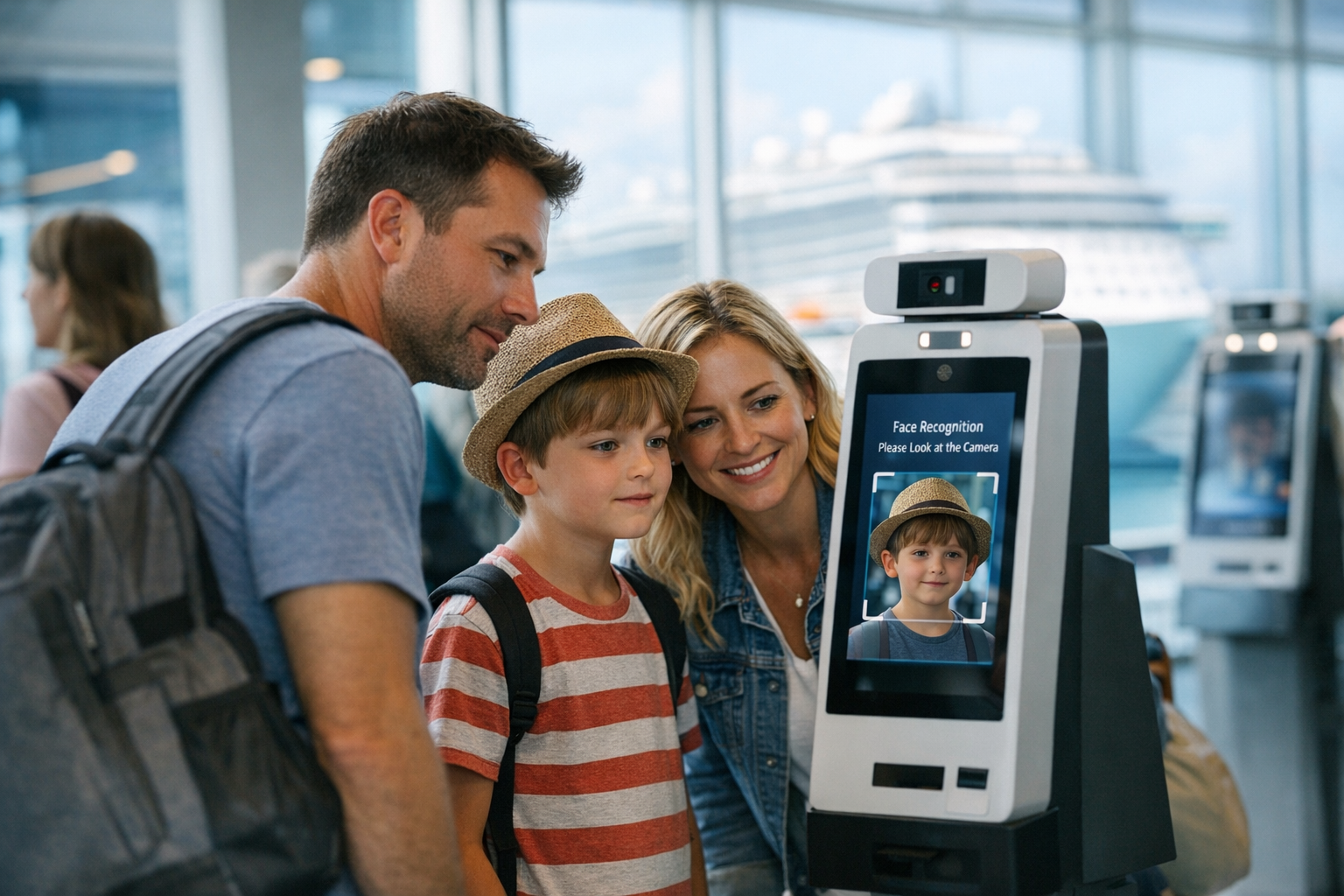
U.S. Customs and Border Protection (CBP) says it has worked with major cruise lines to implement facial biometric comparison technology in the arrival process at select seaports, replacing manual inspection of travel documents with a more automated, touchless identity-verification step.
In a 2023 release about a deployment with Carnival Cruise Line at the Port of Jacksonville, CBP describes the flow: upon debarkation, passengers pause for a photo, which is compared to an existing passport or visa photo in DHS systems. CBP says the process verifies identity within two seconds and has more than 98% accuracy. CBP also notes that eligible travelers may opt out and request a manual document check from a CBP officer.
While CBP’s biometric use case is border-control and not commerce, it matters to payments teams because it conditions passengers to a camera-first experience and encourages cruise operators to expand biometric identity verification into other touchpoints—check-in, venue access, and potentially account-linked authorizations for onboard spending.
From identity to payments: the account-linking layer
Onboard transactions typically ride on a closed-loop “shipboard account” model: guests link a payment card (or other funding source) to an onboard profile, then charges accrue through the voyage and settle according to the cruise line’s rules.
Biometrics don’t replace card networks—but they can replace friction in the authorization moment. If a guest’s identity is verified via face match and linked to their onboard profile, the guest may not need to present a physical card, re-enter a cabin number, or sign receipts for low-risk transactions. The operational promise is shorter lines and higher throughput in high-volume venues like quick-service dining, bars, and excursion counters.
The infrastructure reality: terminals, offline modes, and data plumbing
Cruise is not a normal retail environment. Connectivity can be inconsistent, and operations span shipboard networks, port systems, and back-office platforms. That’s why cruise-focused payment providers emphasize end-to-end orchestration rather than a single “payment method.”
For example, PXP describes cruise payment and check-in solutions that cover mobile check-ins, online card registration, and “store & forward” capabilities designed for remote locations. That kind of architecture is relevant to biometrics because image capture, matching, and account lookup must remain reliable even when bandwidth is constrained—without degrading guest experience or increasing dispute risk.
Fraud and disputes: what changes (and what doesn’t)
Biometric verification can strengthen evidence that the legitimate account holder was present at a specific time and location. In principle, that can improve internal investigations and reduce ambiguity in guest-service disputes (e.g., “that wasn’t my purchase”).
At the same time, biometrics introduces new failure modes:
- False rejects that slow service when lighting, camera angles, or aging templates cause a mismatch.
- Enrollment and consent gaps when guests choose not to participate or opt out.
- Concentrated security risk if biometric templates or identity-linking systems are compromised. Unlike card numbers, faces can’t be “reissued.”
For merchant services and risk teams, the practical takeaway is that biometric “yes/no” should be treated as a signal—not a substitute for layered controls. Expect to still rely on transaction monitoring, velocity checks, device posture (for app-based flows), and traditional payment controls.
Where cruise tech is headed
In a 2025 cruise technology trends piece, Hospitality Upgrade points to seamless payment solutions—including mobile wallets and contactless payments—as part of a broader push toward frictionless guest experiences. Biometrics fits into that trajectory as an authentication layer that can sit alongside contactless and wallet acceptance rather than replacing them.
For travel payments and fintech vendors, the opportunity is to package biometric-ready flows into solutions cruise operators can deploy safely and compliantly: camera-capable terminals, app-based account linking, robust consent and retention policies, and clear fallbacks for opt-out guests.
Key takeaways
- CBP describes cruise-terminal facial biometric deployments that verify identity within two seconds and at more than 98% accuracy, with an opt-out path for manual checks.
- Biometrics can reduce friction in the cruise “shipboard account” model by strengthening identity verification at key moments, potentially speeding onboard commerce.
- Cruise payments require offline-tolerant plumbing (e.g., store & forward) and tight integration across check-in, identity, and point-of-sale systems.
- Biometrics adds new risk considerations—especially around consent, false rejects, and the security of biometric templates and identity links.
Sources: U.S. Customs and Border Protection (CBP), Hospitality Upgrade, PXP